
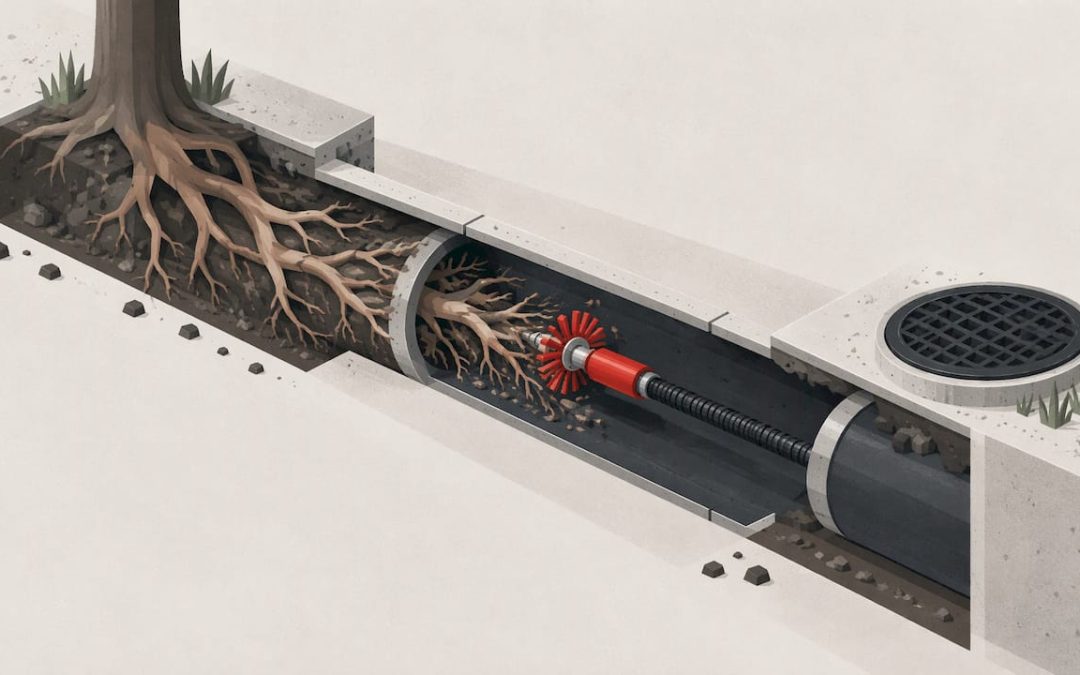
Tree roots in a sewer line are removed in two stages: the roots are cut out of the pipe, then the debris is flushed away with high-pressure water. A camera inspection shows how bad the intrusion is and whether the pipe is damaged. If you live in Port Charlotte, North Port, Venice or South Venice and your drains are slow or gurgling, our team at Liberty Drain Co offers sewer camera inspection, hydro jetting and drain cleaning, with 24/7 emergency response and upfront pricing.
This guide explains what roots do to a pipe, how professionals take them out, what to expect, and what keeps them from growing back.
Key Takeaways
- Gurgling toilets, slow drains and wet spots near floor drains are the classic early signs of roots in a sewer lateral, the pipe that carries waste from your building to the main sewer.
- Roots enter through cracks and loose joints, so cutting them out clears the line but does not repair the opening.
- Professionals combine cutting with hydro jetting, and a sewer camera shows what is in the pipe before and after the work.
- If blockages keep returning, the pipe itself is likely damaged, and repair or replacement is the lasting fix.
- Call a professional at the first signs. Waiting lets roots mat with grease and paper until the line stops completely.
Table of Contents
- Signs Tree Roots Are Blocking Your Sewer Line
- Why Roots Get Into Sewer Pipes
- How Sewer Roots Are Removed
- Why a Camera Inspection Comes First
- Chemical Root Killers: What the Labels Say
- When Roots Keep Coming Back
- Preventing Roots From Returning
- Sewer Root Removal in Port Charlotte
- Our Perspective on Root Problems
- FAQ
- Sources
Signs Tree Roots Are Blocking Your Sewer Line
Roots rarely announce themselves with a sudden blockage. The City of Traverse City, Michigan, lists the first signs as gurgling from toilet bowls and wet areas around floor drains after laundry. If that goes untreated, roots matted with grease and paper can block the lateral completely.
Forbes Home adds several more signs:
- Soggy or wet patches in the yard, which point to a broken pipe
- A sewer smell around the property
- Gurgling toilets and shower drains that drain cleaner does not fix
- Slow drains and repeat backups
- Sinkholes where leaking water undermines the turf
One slow drain in one sink is usually a local clog. Several fixtures slowing at once, or a toilet that gurgles when you run the washing machine, points to the main line. That is the moment to book an inspection rather than reach for another bottle of drain cleaner.
For landlords and property managers, the pattern matters even more. Repeat complaints from different units on the same line are a strong hint of a shared lateral problem, and a stoppage there can affect every tenant at once. If sewage is already coming up, see our guide on what to do in an emergency sewer backup.
Why Roots Get Into Sewer Pipes
Roots do not break healthy pipes on their own. They are drawn to the warm water vapor that escapes a partly full sewer line into cooler soil. According to Traverse City’s sewer department, they follow that vapor to cracks and loose joints. Roots also need oxygen, so they grow in the air space above the water surface, not in a full pipe. They keep growing in winter while the tree above looks dormant.
Once inside, roots expand. They can break the pipe at the crack or joint, and in some cases the pipe collapses and must be replaced.
Two details help you judge your own risk:
- Pipe material. The Wisconsin DNR notes that clay tile pipe installed until the late 1980s is penetrated by roots more easily than plastic PVC, which has fewer joints. Older homes with original clay laterals are the usual suspects.
- Distance. The nearest tree is not always the culprit. The City of Bismarck, North Dakota, says roots can spread 3 to 5 times the height of the tree, and a removed tree’s root system can keep growing for a few years.
How Sewer Roots Are Removed
The standard approach has two parts, and it is worth understanding both so you can read a quote properly.
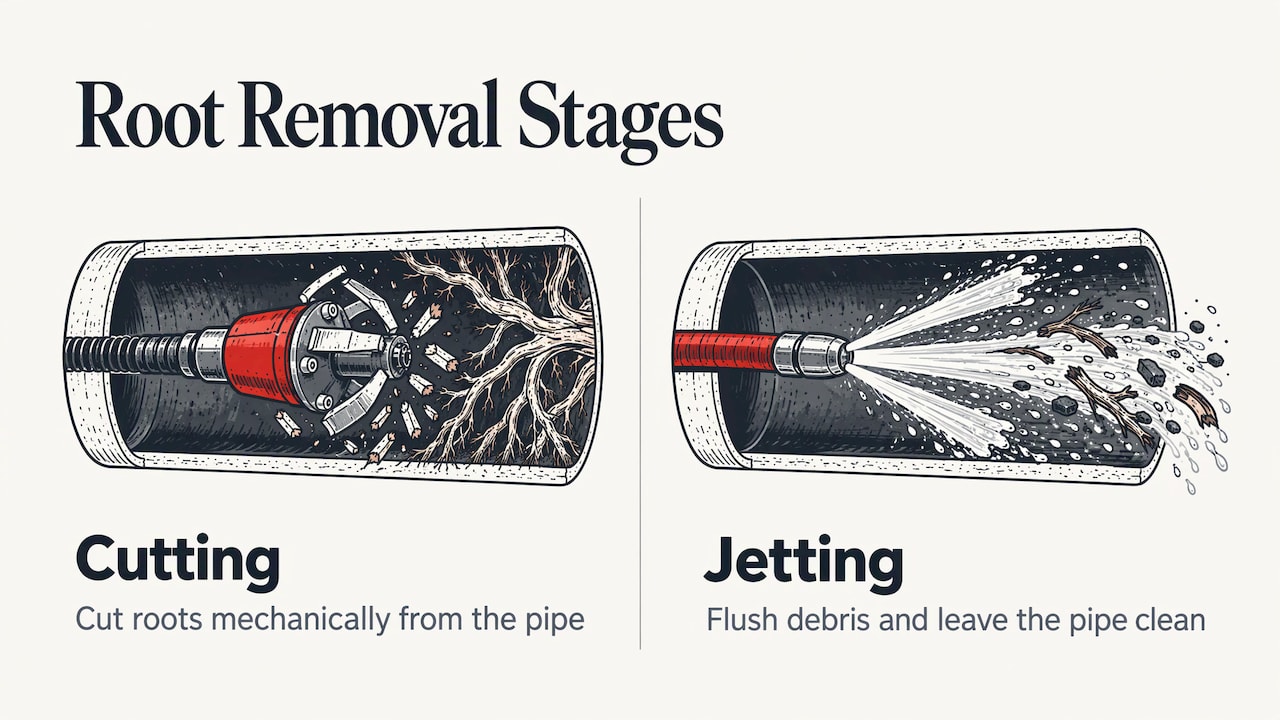
Step 1: Cut the roots out
Plumbing & Mechanical magazine says root cutters, cable machines and jetters are the core tools. Once severe root activity is found, roots must first be mechanically removed. A common method is snaking with a root cutter whose expandable head is sized to the pipe’s inside diameter, cutting roots back to the pipe face. The same article gives a rule of thumb of a 3/4-inch to 1-inch cable for typical 3 to 4 inch residential sewer lines. A wrong cable size can get stuck, whip back or cause injury.
That last point is why this is not a weekend job. Forbes Home notes that heavy-duty sewer snakes large enough for roots are likely too dangerous for most homeowners to run.
The Wisconsin DNR describes the usual cutting attachments as augers, which spin on a cable machine to cut root masses, and root saws, circular toothed heads that grind and cut. It also lists high-pressure flushers that pulverize roots with fast-moving water.
Step 2: Jet the line clean
Cutting leaves debris behind. Plumbing & Mechanical says a sewer jetter is then used to remove the root debris remaining after cutting. Hydro jetting sends pressurized water through the pipe and washes out roots, grease, scale and sediment, so the line is left clean from wall to wall instead of with a hole punched through the middle. Spartan Tool’s guide puts the division of labor simply: cable machines cut hard obstructions like roots, and jetters blast away soft ones like grease. It adds that a jetter can also drive a hydraulic root cutter for heavily root-impacted lines.
Our hydro jetting service page explains what the process is and what it costs. For a root-clogged line, jetting is the step that leaves the pipe clear and gives a camera a clean view of what is underneath.
What it looks like on the day
For a typical lateral, expect this sequence:
- Locate the access point, usually a cleanout, which is a capped pipe opening near the house or in the yard.
- Inspect the line with a camera to find the roots and any damage.
- Clear the roots and flush the line.
- Run the camera again to confirm the pipe is open and see the condition of the walls and joints.
- Discuss the findings and any repair that is needed.
Why a Camera Inspection Comes First
Without a camera, a contractor is working blind. The EPA calls CCTV the mainstay of sewer condition assessment. A camera travels through the pipe to locate and describe defects and create a permanent video record, capturing roots, cracks, sags, offset joints and leaks. The EPA report also notes the camera can see only pipe surfaces above the waterline, which is another reason to clear the line first.
The footage answers the questions that decide your next step:
- Are the roots fine hair-like growth or thick masses?
- Is there one entry point or several?
- Is the pipe cracked, sagging or separated?
- Is it clay, cast iron or plastic?
The Metropolitan Water Services in Nashville uses cameras for much the same reasons: confirming pipe material, size and lateral locations, finding obstructions such as roots, and spotting structural defects that may lead to future failures.
There is one more benefit. A NASSCO publication explains that roots at a joint do not by themselves mean the joint has separated unless a gap with soil is visible. Reading the footage correctly prevents unnecessary repairs, and that is what you want from a quote.
If you are buying or selling a property, the same inspection doubles as a pre-purchase check. We cover that in what a sewer scope inspection finds and costs.
Chemical Root Killers: What the Labels Say
Copper sulfate and foaming root killers come up in almost every search on this topic, so here is what the official labels say. They are not a substitute for clearing a blocked line.
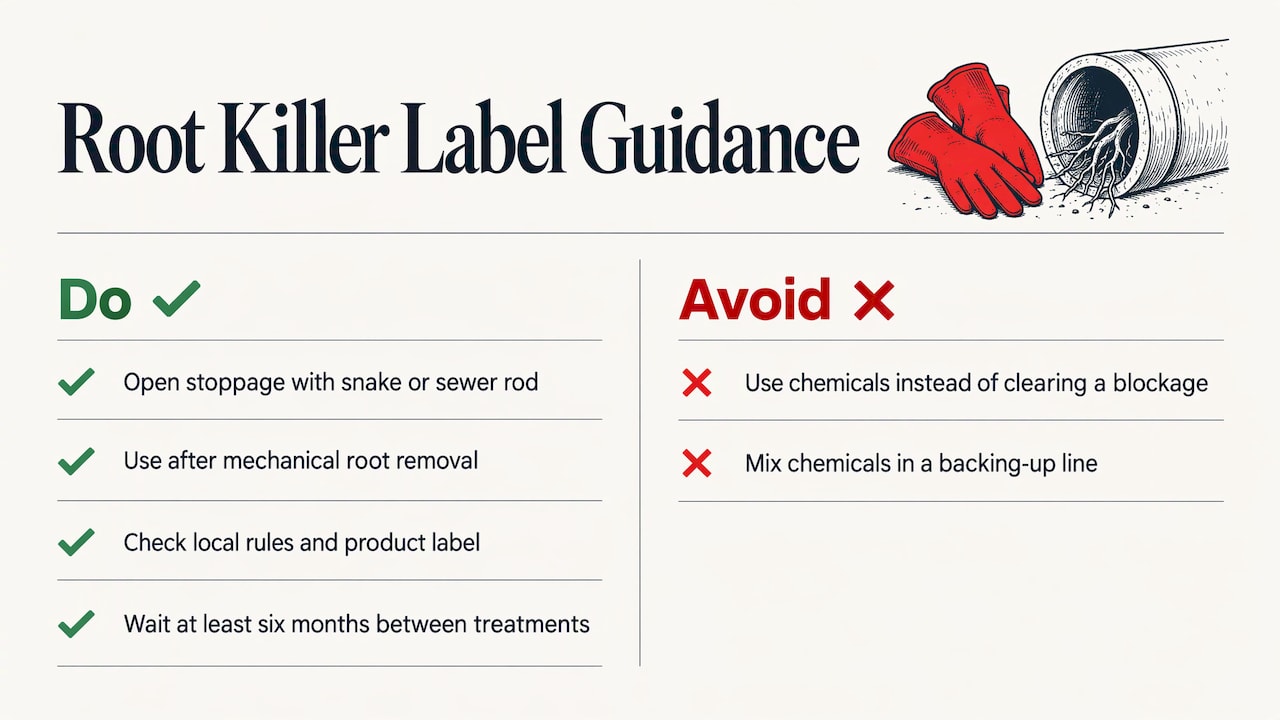
The EPA label for one copper sulfate root product says a complete stoppage must first be opened with a snake or sewer rod. The label allows several days to two weeks for roots to absorb the chemical, die and wash away, and sets a minimum six-month interval between treatments. It prohibits use in Connecticut and the San Francisco Bay Area. Another EPA-registered copper product is classed DANGER: corrosive, with a risk of irreversible eye damage and requirements for goggles, long sleeves and chemical-resistant gloves.
Plumbing & Mechanical says chemicals are best used as preventive maintenance after mechanical root removal, not instead of it. Some local utilities restrict copper products for environmental reasons, so check local rules and the product label before you use anything. Never mix chemicals in a line that is already backing up.
When Roots Keep Coming Back
If you have had roots cleared more than once, the roots are not the real problem. The opening in the pipe is.
The City of Bismarck says repeated blockage indicates a collapsed or badly damaged line. Mechanical or chemical control is a temporary fix that must be repeated until the defect is corrected, and the best solution is to repair or replace the line. Removing the tree will not fix cracked or broken pipe, as Cleveland’s guidance also points out.
The repair options, from least to most invasive:
- Clear and monitor. Fine for a single minor intrusion on a sound pipe.
- Lining. Plumbing & Mechanical describes cured-in-place pipe (CIPP) epoxy lining as the last-resort alternative to digging, sealing openings and gaps to stop leaks and future root intrusion.
- Replacement. Needed when the pipe has collapsed or is badly broken. Local ordinances can dictate pipe material for the city connection.
Digging, lining and replacement are repair work, and they are decided on the evidence of a camera inspection. A clear picture of the damage is the best way to avoid paying to clear the same line again and again.
Preventing Roots From Returning
Some simple habits cut the odds:
- Plant with distance in mind. Four Rivers Sanitation Authority in Illinois advises planting new trees at least 10 feet from sewer pipes.
- Choose the right species. Mt. View Sanitary District in California suggests slow-growing trees with a small root area near lines and vertical root barriers buried beside the pipe.
- Call 811 before you dig. The same district reminds homeowners to call 811 before any yard digging, so you do not hit buried lines.
- Schedule maintenance. Cleveland recommends snaking sewer lines every 12 to 18 months on lines prone to roots. For a rental or commercial property, a recurring service visit costs far less than an emergency during a tenant’s busy week.
- Act on early signs. Frequent unexplained clogs and gurgling are the cue to book an inspection.
Sewer Root Removal in Port Charlotte
If your line has roots, or you suspect it does, we handle the work from diagnosis to a clear pipe. Our drain cleaning, hydro jetting and sewer camera inspection services cover homes and businesses in Port Charlotte, North Port, Venice and South Venice. We use sewer camera inspections to identify the cause, hydro jetting to clear the line, and we price upfront so you know the cost before work begins. Emergency response is available 24/7.
See our drain cleaning and hydro jetting services to book a visit, or look at past projects to see our work. For single-family homes, landlords with several units and commercial properties, the first step is the same: find out what is in the pipe.
Our Perspective on Root Problems
Most customers call us after the second or third backup, when a drain cleaner or a quick fix did not hold. The pattern is usually the same: the clog was a symptom, and the cause sits somewhere in the line.
That is why we pair cleaning with a camera. Hydro jetting clears the line, and the inspection shows whether roots, a cracked section or an offset joint is behind it. Our approach is built to clear the clog and address the root cause so the blockage does not come back.
We believe in upfront pricing and in being reachable at any hour, because a sewer problem does not wait for business hours. If you see gurgling, slow drains or wet spots, call early. A line cleared before it stops completely is a smaller job.
Scott
FAQ
What do plumbers use to remove roots from pipes?
The core tools are root cutters on cable machines and sewer jetters. Cutters with expandable heads trim roots back to the pipe wall, and jetting flushes out the debris left behind, according to Plumbing & Mechanical. A camera is used to see the roots and the pipe condition.
How do I know if my sewer line is clogged by roots?
Look for gurgling toilets, slow drains in several fixtures, wet areas around floor drains, sewer odors and soggy patches in the yard. Drain cleaner that does not help is another hint. A camera inspection confirms whether roots are the cause.
How long does copper sulfate take to dissolve roots?
One EPA-approved product label allows several days to two weeks for roots to absorb the chemical, die and wash away. The same label says a fully blocked line must be opened mechanically first. Follow the label and local rules for any product.
Will the roots grow back after removal?
They can. Roots keep following moisture to any crack or loose joint, so unless the opening is repaired, cutting and jetting only clear the line for a time. A camera inspection shows whether the pipe needs lining or replacement to stop repeat blockages.
Can I just remove the tree?
Usually that does not solve it. Cleveland’s guidance says removing the tree will not fix cracked or broken pipes, and a removed tree’s roots can keep growing for a few years.
Sources
- Tree Root FAQ, City of Traverse City Sewer and Water
- What To Do About Tree Roots In A Sewer Line, Forbes Home
- Collection System Maintenance Part 2, Wisconsin DNR
- Sewer Lines and Trees, City of Bismarck
- Master the basics of sewer root removal, Plumbing & Mechanical
- Sewer Jetter Applications, Spartan Tool
- Report on Condition Assessment Technology of Wastewater Collection Systems, US EPA
- Remote-controlled cameras provide eyes for underground pipe repairs, Clean Water Nashville
- Every Separated Joint, NASSCO
- Pesticide Product Label, Hercules Breakthru R-D, US EPA
- Root Killer product label, Fertilome
- Treating Defective Sewer and Water Lines for Tree Roots, City of Cleveland
- Homeowner Sewer Tips, Four Rivers Sanitation Authority
- Root Intrusion, Mt. View Sanitary District