
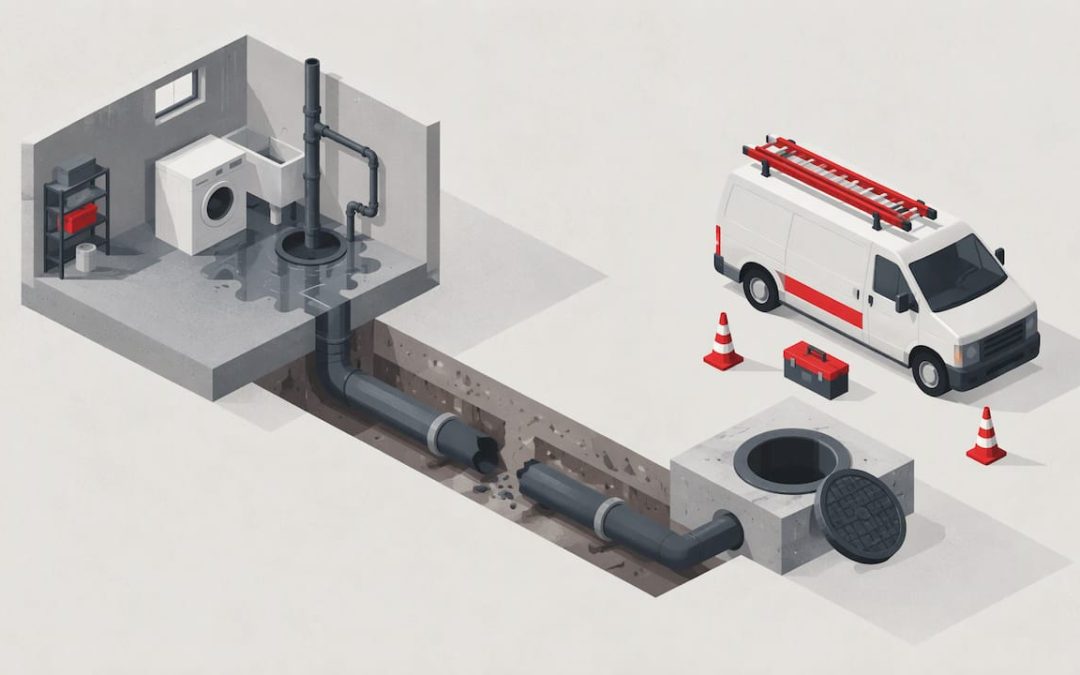
If sewage is coming up through a floor drain, toilet or tub, stop using water, keep people and pets out of the affected area, and call a drain professional right away. Do not try to clear a main sewer line yourself. Liberty Drain Co is a family-owned drain cleaning company in Port Charlotte, FL, and we offer 24/7 emergency response, sewer camera inspection and hydro jetting, so the cause of the backup is found and cleared instead of guessed at.
This guide is for homeowners, landlords, property managers and business owners. It covers what to do in the first minutes, how to tell whether the blockage is on your property or in the public sewer, what makes sewage a health risk, how urgent sewer line service works, and what to check with your insurance.
Key Takeaways
- Stop all water use at once: no flushing, no laundry, no dishwasher, no running faucets.
- Sewage is a health hazard. Keep people and pets away, and do not try to stop it from coming up through floor drains.
- The pipe from your building to the public sewer main is normally the property owner’s responsibility, so a blockage there needs a professional on site fast.
- A sewer camera inspection shows what is blocking the line and where, so the repair targets the cause and not just the symptom.
- Call your insurer early and photograph the damage. Standard policies often treat sewer backup as an add-on coverage.
Table of Contents
- The First Steps When Sewage Backs Up
- Is the Blockage in Your Line or the Public Sewer?
- Why Sewage Is a Health Hazard
- How Urgent Sewer Line Service Works
- Emergency Sewer Service in Port Charlotte
- Landlords, Property Managers and Businesses
- Insurance: What to Check Right Away
- Does a City Pay for a Backup?
- Preventing the Next Backup
- Our Perspective
- FAQ
- Sources
The First Steps When Sewage Backs Up
The first hour decides how far the damage spreads. Every gallon of water you send down the drain has nowhere to go but back into your building, so the first job is to stop adding to it.
- Stop running water. The Madison Metropolitan Sewerage District tells residents to stop running water and report the backup right away. That means toilets, sinks, showers, washing machines and dishwashers.
- Do not fight the flow. Seattle’s utility guidance says not to try to stop sewage coming up through floor drains. Plugging a drain by hand or with rags can push the problem into another fixture.
- Cut power where water is standing. The City of Lincoln, Nebraska advises turning off electrical power to the affected area if appliances or fixtures are touching standing water. If reaching the panel means stepping into the water, call an electrician or the utility before you go near it.
- Keep people and pets out. Children, pets and anyone with a weakened immune system should stay out of the room.
- Note what is happening. Which fixtures are backing up? Did it start when someone flushed or ran the washer, or did it appear when nothing was running? That detail helps the technician and, as the next section shows, points to where the blockage sits.
- Call for emergency drain service. Sewage that is already on the floor does not wait for business hours. Our team is available 24/7 for sewer backups and clogged drains in Port Charlotte, North Port, Venice, South Venice and the rest of Sarasota County.
- Take photos before you clean. Lincoln’s guidance also suggests taking photographs of damage for documentation. You will want them for your insurer.
Is the Blockage in Your Line or the Public Sewer?
This question decides who fixes the problem and who pays, so it is worth answering early.
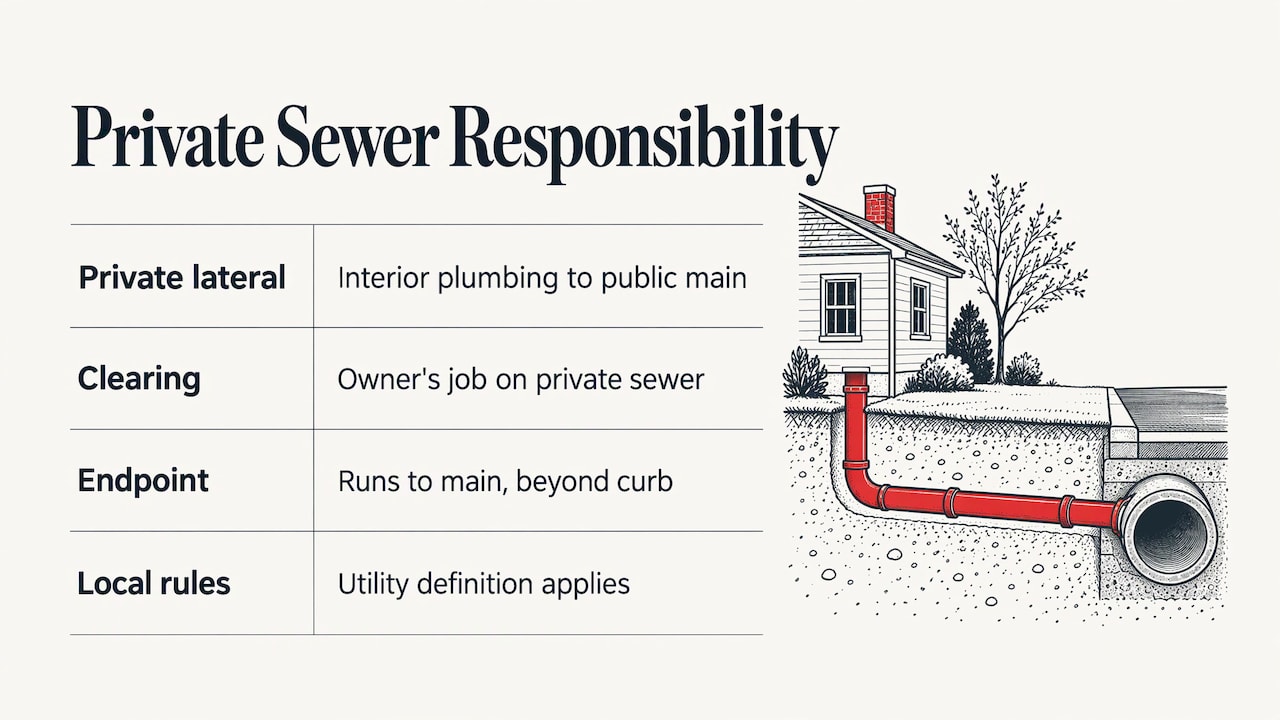
Your building connects to the public sewer main through a buried pipe, often called the private sewer lateral or service line. The City of Oshkosh explains that this private building sewer runs from the interior plumbing to the public sewer main, usually under the street or alley, and that clearing a blockage in it is the owner’s job. The Oro Loma Sanitary District in California says the same, adding that the lateral does not end at the curb or property line but runs all the way to the main. Local rules differ, so your own utility’s definition applies, but the pattern is common across U.S. cities.
Clues from the symptoms
Fairfax County, Virginia gives a useful rule of thumb. If a backup happens only when a toilet, tub, washer or sink is used, a plumber is likely needed. If sewage backs up when nothing is in use, the problem may be in the public main line.
In practice:
| What you see | What it often points to |
|---|---|
| One drain is slow or backed up | A clog in that fixture’s branch line |
| Several drains back up together, especially the lowest ones | A blockage in the main drain or private sewer line |
| Toilet gurgles or water rises in the tub when the washer drains | A main line restriction |
| Backup when nothing has been running, or neighbors have the same problem | A possible issue in the public sewer |
If neighbors are affected too, contact your sewer utility. If the public sewer is working normally, the Metropolitan Sewer District of Greater Cincinnati notes that the private building sewer may be the cause, and that a qualified plumber can locate underground pipes and video-inspect the line after cleaning it.
What commonly causes the blockage
MSD Greater Cincinnati lists the usual causes of clogs and breaks in private sewer lines: tree roots, grease and cooking oil, wet wipes, diapers and hygiene products, age-related deterioration, and ground shifting. Roots are a particular concern because they grow toward cracks in search of water and can form dense root balls inside the pipe, as the Oro Loma district points out.
That list matters for repair. A grease clog and a root intrusion need different treatment, and a cracked pipe needs more than cleaning. You cannot tell which one you have from the surface.
Why Sewage Is a Health Hazard
Sewage carries bacteria, viruses and other pathogens. Treat every backup as contaminated, even when the water looks fairly clear.
Official guidance is consistent on a few points:
- Porous materials. Seattle’s utility advises residents to discard items exposed to sewage and to sanitize or remove and discard paneling, wallboard or wall coverings within 24 hours. Carpet and padding that soaked up sewage are generally treated the same way.
- Hard surfaces. Seattle’s protocol is to wash with hot water and mild dish detergent, then rinse with a solution of eight tablespoons of liquid household bleach in one gallon of water, and let the surface air dry. Never mix bleach with ammonia or other cleaners.
- Kitchens and food areas. The Houston Health Department says surfaces touched by sewage should be disinfected with EPA-registered disinfectants labeled for norovirus, and that metal utensils, pots and pans should be boiled for at least 10 minutes or run through a heat-sanitizing dishwasher.
- Removing the water. Madison’s sewerage district advises removing all water and sewage as quickly as possible once the drain flows again, with the wastewater properly disposed of by pumping services or flood restoration companies.
Wear waterproof gloves, boots and eye protection if you must enter the area, wash your hands thoroughly afterward, and keep children and pets away until the cleanup is done. Anyone who develops stomach illness, skin infection or other symptoms after exposure should contact a doctor.
Restaurants and other food businesses
If you run a food establishment, the rules are stricter. The Houston Health Department guide tells operators to close the emergency cut-off valve to the affected pipes, stop all food operations and notify the health department. The establishment must have approval before it resumes food operations, and no imminent health hazard may exist. Check your own county health department for the local procedure.
How Urgent Sewer Line Service Works
A good emergency visit does two things: it restores flow, and it finds out why the line failed. Clearing the symptom without the cause is how a backup returns three weeks later.
Step 1: Restore flow safely
The technician locates the blockage and clears the line enough for wastewater to move again. Once water drains, the cleanup can begin. This is the point where property owners stop the damage from growing.
Step 2: Look inside the pipe
A sewer camera inspection puts a camera inside the line so the cause is seen, not assumed. It can show grease buildup, roots, a bellied or broken section, or an object lodged in the pipe. MSD Greater Cincinnati notes that a plumber should be able to video the line and make a recording that can be submitted to the sewer district if needed. A recording is also useful evidence for an insurance claim or a dispute over whose pipe failed.
Step 3: Clear the line fully
When the camera shows heavy grease or scale, a blockage that keeps coming back, or roots in the line, hydro jetting uses pressurized water to scour the pipe walls. Standard drain cleaning handles many simpler clogs. Which one fits depends on what the camera finds, and our approach is to clear the clog and address the root cause so the blockage does not return.
Step 4: Decide on repair or prevention
If the inspection shows damage, such as a crack or collapsed section, you have the footage to decide on the next step. If the line is simply dirty, regular maintenance can keep it that way.
Emergency Sewer Service in Port Charlotte
Liberty Drain Co is a family-owned drain cleaning company serving homes and businesses in Port Charlotte, FL, including North Port, Venice, South Venice and Sarasota County. For a backup, we offer:
- 24/7 emergency response
- Sewer camera inspection to identify the cause accurately
- Hydro jetting for stubborn and recurring blockages
- Drain cleaning for clogs in lines of every kind
- Upfront, transparent pricing
Customers have reported that we resolved chronic problems where earlier attempts had not. You can see examples of our jobs on the Our Work page, and the full list of services is on the services page.
If sewage is backing up now, do not wait for it to stop on its own. Contact Liberty Drain Co through our site and tell us which fixtures are affected, and we will get a technician moving.
For landlords and property managers, a camera recording of the line gives you a clear record of what happened and what was done, which helps when tenants, owners or insurers ask.
Landlords, Property Managers and Businesses
A backup in a rental or commercial building raises questions a single-family homeowner does not face.
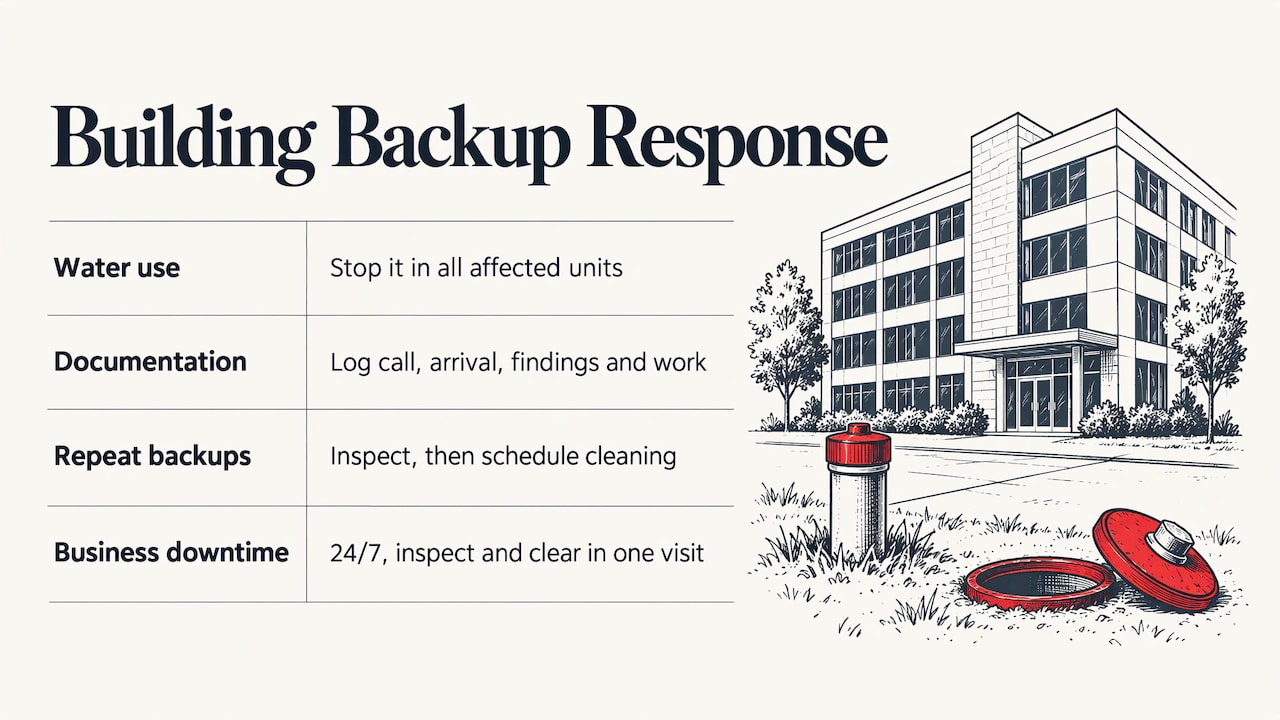
Tenants and habitability. Sewage in a living space is an urgent problem for everyone in the building. Stopping water use in all units on the affected line is the fastest way to limit damage, because a shared line backs up into the lowest fixtures first.
Documentation. Keep a log: when the call was made, when the technician arrived, what was found and what was done. Photos, a camera recording and a written service record support insurance claims and any conversation with the utility.
Recurring blockages. A building that backs up more than once usually has a cause that cleaning alone does not remove, such as grease from a kitchen, roots, or a damaged section. Inspect the line, then set a cleaning schedule that fits the findings. Restaurants and other kitchens produce a lot of grease, which MSD Greater Cincinnati lists among the leading causes of private sewer blockages.
Business downtime. For a business, every hour of closure costs money. A call that reaches a team with 24/7 availability and the equipment to inspect and clear the line in one visit shortens that time.
Insurance: What to Check Right Away
Many homeowners assume a sewage backup is covered, then learn it is not. The way to find out is to read your policy now and call your insurer promptly after a backup.
- Ask whether you have sewer or drain backup coverage. The City of Lincoln advises homeowners to contact their insurer to confirm whether homeowner’s or renter’s coverage applies to sewage backup and to consider adding coverage if it is missing.
- Look for limits. One example is an Auto Club of Missouri homeowners form that covers water backing up through sewers or drains up to $5,000 for an additional premium. Limits and deductibles vary by insurer and state, so check your own declarations page.
- Document everything. Photos, the service invoice and a camera recording of the line help show what happened.
- Tell your insurer before you discard damaged items, unless health safety requires removal, and then photograph them first.
Renters and tenants should check their renter’s policy and tell the landlord or property manager the same day.
Does a City Pay for a Backup?
Sometimes a city or sewer district offers a claims process when the public sewer is at fault. MSD Greater Cincinnati, for example, sends a crew to investigate, usually within 4 hours, and requires reports within 48 hours of discovery for potential reimbursement through its Sewer Backup Program. Programs and deadlines differ by utility. If you think the public main is involved, report it to your local utility promptly, keep your documentation, and ask what its process and deadlines are.
Preventing the Next Backup
Most repeat backups have a cause that can be dealt with.
- Keep grease out of drains. Cooking fat and oil cool and harden inside pipes. Wipe pans into the trash.
- Flush only toilet paper. MSD Greater Cincinnati lists wet wipes, diapers and hygiene products among the causes of private sewer clogs, even when a package says flushable.
- Mind the trees. Oro Loma advises against planting trees or building expensive landscaping over the top of the sewer lateral, because roots grow toward cracks and form root balls that clog the line.
- Consider backflow protection. Lincoln’s prevention guide describes four options: a checkvalve, floor drain plug, floor drain standpipe or overhead sewer. A checkvalve lets sewage flow in one direction only, while a floor drain plug is simple and inexpensive but works only until sewage rises to the next opening.
- Inspect after a backup. A camera inspection shows the true condition of the line, and a hydro jetting visit clears buildup from pipe walls so flow stays full-bore.
Our article on why professional drain cleaning matters in Port Charlotte covers the maintenance side in more detail.
Our Perspective
We are a family-owned crew in Port Charlotte, and the backups that worry us most are the ones that have happened before. A line that has been snaked and left alone will often block again, because the clog was a symptom of grease, roots or a damaged section.
That is why we pair clearing the line with a camera inspection. When you can see the inside of the pipe, you stop guessing, and the repair or maintenance plan fits what is really there. Hydro jetting then removes buildup from the pipe walls instead of poking a hole through it.
We also believe you should know the price before work starts. A sewer backup is stressful enough without a surprise at the end of it. We are available 24/7 because sewage does not keep office hours.
If your drain has backed up more than once, treat it as a signal. Get the line inspected, fix the cause, and the next emergency may never happen.
Scott
FAQ
How does a sewer get backed up?
A blockage or break in the sewer line stops wastewater from flowing out, so it rises into the lowest drains. Common causes include tree roots, grease, wipes and hygiene products, aging pipe and shifting ground, according to MSD Greater Cincinnati. A camera inspection shows which one is behind yours.
Is sewage backup a health hazard?
Yes. Treat all sewage as contaminated, keep people and pets away, and wear gloves, boots and eye protection if you must enter the area. Seattle’s utility advises discarding exposed items and removing wet wallboard and wall coverings within 24 hours. See a doctor if anyone becomes ill after exposure.
Does homeowners insurance cover sewage backup?
Often only with a separate sewer or drain backup endorsement, and with a dollar limit. Read your policy and call your insurer promptly, as Lincoln’s guidance recommends. Photos, invoices and a line inspection recording support the claim.
Who is responsible for the sewer line, me or the city?
In most U.S. cities the owner is responsible for the private line from the building to the public main, and the utility maintains the main itself. Fairfax County is one example. Your local utility’s rules decide the exact boundary.
Can I use drain cleaner on a sewage backup?
No. Do not pour chemicals into a backed-up main line, and do not run more water through it. Stop using fixtures and call for professional emergency service so the line is cleared and inspected properly.
Sources
- After the Sewer Backup – Tips for Homeowners, City of Lincoln, NE
- Handling a Sewer Backup, Madison Metropolitan Sewerage District
- What to Do When Sewage Backs Up, Houston Health Department
- Wastewater FAQ, Fairfax County Public Works
- Sewer Maintenance, City of Oshkosh
- Sewer Backups and Other Issues, MSD Greater Cincinnati
- Got Sewer Trouble?, Oro Loma Sanitary District
- Side Sewer Backups, Seattle Public Utilities
- Sewer Backup Prevention Options for Homeowners, City of Lincoln, NE
- Homeowners insurance form CO049507-05, Auto Club of Missouri